
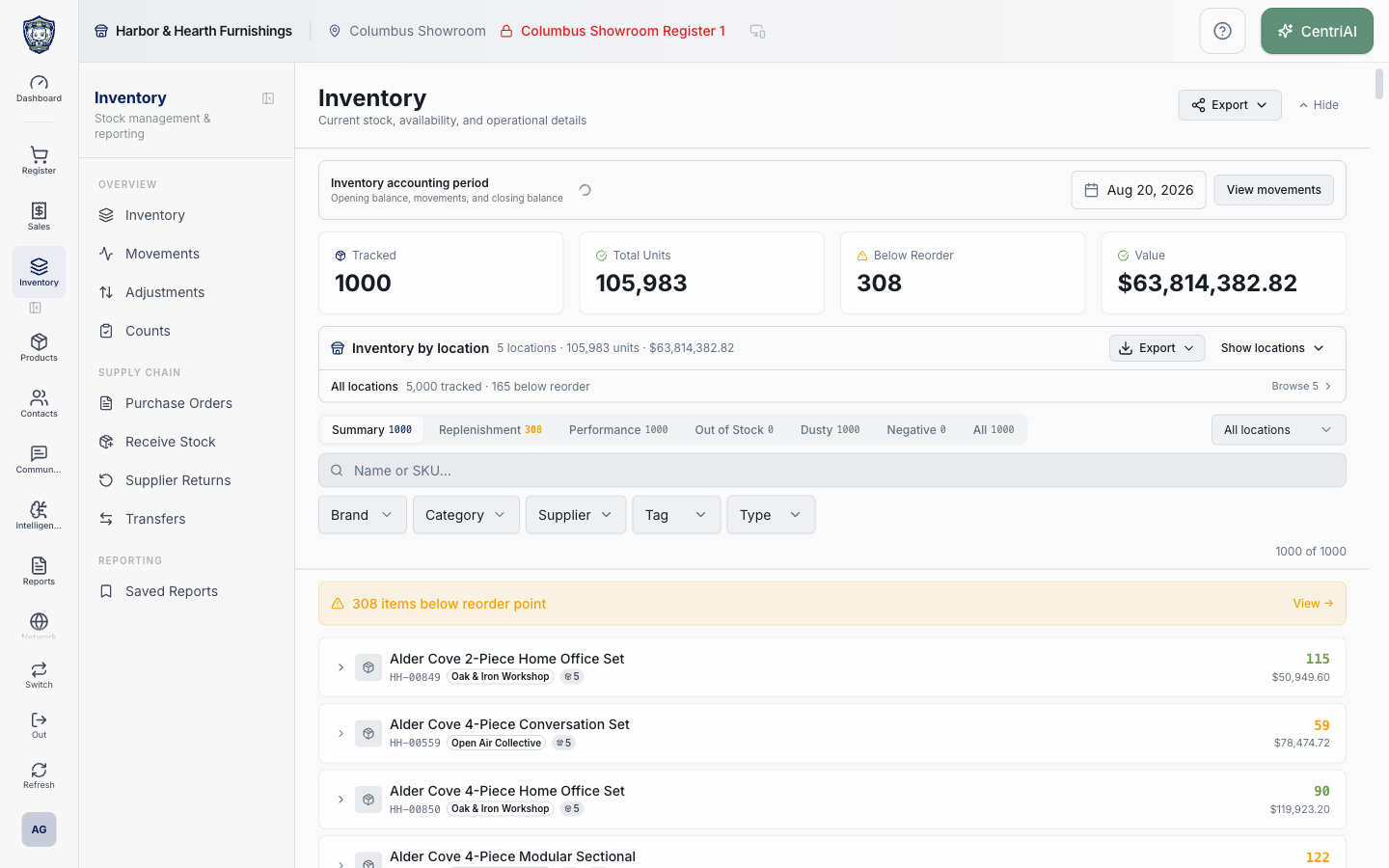
Inventory → Network Inventory opens the dedicated /inventory/network workspace for an HQ-enabled role. It is not the ordinary Inventory screen in an all-location mode, and /network/inventory is a different route. This screen is read-only: it does not adjust inventory, reserve stock, create a transfer, or prove that units are available to promise.
Before you beginConfirm the location, product, variant, and unit of measure. Inventory actions create an operational audit trail and can affect availability immediately.
Step by step
- Go to Inventory → Network Inventory. The navigation item and page heading use the Globe icon. This Enterprise navigation item is HQ-only, so it may be absent when the current role or business is not eligible.
- Confirm the enterprise context. The screen aggregates the network represented by the current HQ identity rather than only the active selling location.
- Read the five summary cards: Franchisees counts represented businesses, Products counts grouped master products, Network Units sums recorded stock-on-hand, Below Reorder counts represented location exceptions, and Network Value aggregates stock value. Cost-restricted roles see dots instead of Network Value.
- Use All, In Stock, Below Reorder, Zero, or Negative. In Stock, Zero, and Negative classify each product by its filtered aggregate quantity. Below Reorder includes a product when at least one represented location has positive stock below its reorder point.
- Search by grouped product name or master SKU. This search does not match brand, business, location, variant name, or variant SKU.
- When more than one business is represented, open Franchise and select one or more businesses. The visible product rows, stock totals, reorder count, and value are recalculated from those tenant rows. Choose Clear all to restore the full represented network.
- Read the result count as visible products out of the full loaded product count. If no products appear, clear Search, choose All, and clear the Franchise filter before treating the result as missing inventory.
- Open a product row. The collapsed row shows its name, master SKU, brand on wider screens, participating-business count, variant count when present, location-level reorder exceptions, aggregate units, and permitted value and HQ retail information. Discontinued marks a deprecated HQ/master record; it does not erase local stock.
- For a simple product, expand the business row, then read each location’s stock-on-hand and configured reorder point. For a variable product, expand the intended variant first, then its business row, so you compare the exact SKU rather than only the master total.
- Use the retail badge only as an HQ price comparison when price visibility is permitted: green is a match within one cent, amber is above HQ, and red is below HQ. It is not an inventory-health or margin indicator.
- Treat Network Units as recorded on-hand and Network Value as an operational cost aggregation. Neither accounts for commitments, incoming supply, open purchase orders, transfer-in-transit quantities, or fulfillment availability. Negative stock can reduce the totals.
- Use Network Transfers for a cross-business request or movement, and use the appropriate local count or adjustment workflow to correct a location quantity. Before promising an item, confirm the exact business, variant, location, and current fulfillment state in the operational workflow.
Screen and contract reference
| Control or area | What it means |
|---|---|
| Globe icon | Exact CentriPOS navigation and screen icon for Inventory → Network Inventory. |
| HQ-only | The Inventory navigation entry is limited to eligible headquarters access. |
| Franchisees | Distinct participating businesses represented by the loaded network products. |
| Products | Grouped master-product count returned by the network inventory source. |
| Network Units | Sum of recorded stock-on-hand across represented product, business, and location rows. |
| Below Reorder summary | Number of represented locations with stock greater than zero and below their reorder point. |
| Network Value | Aggregated stock-on-hand value; hidden when cost visibility is restricted. |
| All | Every product remaining after Search and Franchise filters. |
| In Stock | Products whose filtered aggregate stock is greater than zero. |
| Below Reorder tab | Products with at least one positive-stock location below its reorder point. |
| Zero | Products whose filtered aggregate stock equals zero. |
| Negative | Products whose filtered aggregate stock is below zero. |
| Search product name or SKU | Matches only grouped product name or master SKU. |
| Franchise filter | Limits represented businesses and recalculates the product rows and their filtered totals. |
| Product row | Grouped master-product summary with participating-business, variant, reorder, unit, value, and HQ retail context as permitted. |
| Discontinued | HQ/master record is deprecated while represented stock can remain visible. |
| Variant row | Exact variant name, SKU, network units, business count, reorder exceptions, and permitted HQ retail reference. |
| Business row | Participating-business retail comparison, location count, reorder count, and total units. |
| Location row | Exact location stock-on-hand and configured reorder point. |
| Retail comparison badge | Green matches HQ within one cent, amber is above HQ, and red is below HQ. |
| Read-only boundary | No inventory adjustment, reservation, purchasing, movement, or transfer is performed on this screen. |
| Available-to-promise boundary | A positive recorded quantity does not prove that units are uncommitted and ready for a new sale. |
Expected result
The dedicated HQ Network Inventory screen shows the intended represented businesses and exact product or variant totals; Franchise, stock-state, search, reorder, value, and retail-comparison evidence reconcile to the expanded location rows without being mistaken for available-to-promise inventory.
Troubleshooting
- Confirm the exact product variant and stock location before posting a quantity change.
- Use the movement ledger to identify the source workflow instead of correcting history directly.
- Avoid a manual adjustment when receiving, transfer, count, sale, or return is the correct workflow.
CentriPOS API explorer · API Center administration
More guides
Build an itemized payment in MoneyUse Products or Amount & description to build one receipt, attach the customer, and follow the appropriate payment or service-estimate workflow.
Take a one-time payment in Virtual TerminalReview a one-time amount, tax and contact at the correct payment station, use its verified secure checkout, and recover the original receipt after an uncertain result.
Review booking payments, refunds and earned careKeep a booking’s customer payments, unused advances, completed care, cancellation fees and refunds distinct, then read a correctly scoped accrual report.
Configure booking properties and customer pagesSet accommodations, service packages, availability, required intake and payment terms, then review the correctly branded booking page before sharing it.